RealCISO vs Cynomi
Both platforms help service providers deliver cybersecurity services. The difference is what happens after the assessment — and whether your clients’ security programs actually improve over time.
Both platforms help service providers deliver cybersecurity services. The difference is what happens after the assessment — and whether your clients’ security programs actually improve over time.
| Capability | RealCISO | Cynomi |
|---|---|---|
| Platform identity | Compliance intelligence platform | AI-assisted vCISO & GTM platform |
| L1–L5 maturity trajectory per control | ✓ Yes — tracked over time, predictive audit readiness | ✗ Point-in-time only; cannot build trajectory retroactively |
| Impact simulation (what-if scoring) | ✓ simulate_project — ranks gaps by projected score improvement before acting |
✗ No published what-if or projected-impact capability |
| AI engine | ✓ Cleo — one agent reasoning over a persistent compliance data graph (Controls→Risks→Evidence→Vendors→Policies→People) | CISO Intelligence — four role-based agents (CISO, Auditor, Analyst, Executive Communicator) generating outputs per engagement |
| AI remediation workflows | ✓ Cleo generates ranked remediation workflows by projected score impact | AI-assisted remediation plans and triage; not ranked by projected score impact |
| Compliance frameworks | ✓ NIST CSF 2.0, HIPAA 2.0, SOC 2, ISO 27001, CIS Controls v8, NIST 800-171, NIST 800-53, CMMC 2.0, PCI-DSS, FedRAMP, RMF, NIST AI RMF — 1,000+ controls pre-baked. Every framework included; no per-framework fees, ever. | 40+ frameworks (self-reported), delivered per engagement or per plan |
| Multi-framework single assessment | ✓ HIPAA 2.0 + NIST CSF 2.0 simultaneously; one evidence set maps to both | Automated cross-mapping available |
| Continuous compliance integrations | ✓ 15 integrations · 386 automated tests across cloud (AWS, Azure, GCP), identity (Microsoft 365, Google Workspace, Okta), endpoint & MDM (Intune, Jamf, Kandji, ConnectWise), EDR (CrowdStrike) and vulnerability management (Qualys, Tenable) — 12-hour sync cadence | 7 vulnerability-scanner integrations (Tenable, Rapid7, CrowdStrike Falcon Spotlight, SentinelOne, Tanium, Upwind, Qualys) with scheduled scans, added June 2026 |
| What the integrations actually produce | ✓ Three layers, kept separate: Evidence (raw snapshots) → Tests (pass/fail observations) → Control Assessment (a human decision). Automated tests inform the assessor; they never silently change a control's status | Scanner findings feed remediation and evidence workflows; no published separation between machine observation and assessed control state |
| Portfolio intelligence (MSP multi-tenant) | ✓ Cross-client pattern recognition, evidence expiration by risk priority, per-client maturity benchmarks | Portfolio-level revenue and opportunity insights; cross-client maturity benchmarking not published |
| Risk rollup for client communication | ✓ Risks rolled up — typically 6 high-level items per client for executive reporting | No rollup — discrete task and risk lists (field data: 396 tasks / 39 risks on a single NIST CSF client) |
| Evidence expiration as active signal | ✓ Expiring evidence ranked by risk impact and audit proximity; a year-at-a-glance evidence board colour-codes every collection period; controls and scores update automatically | Centralised files repository for reports and compliance documentation; expiration-ranked prioritisation not published |
| Audit request tracking | ✓ A tracked request list — seeded from assessor requirements or a target maturity level, each request owned and dated, moving Open → Ready → Submitted → Accepted. Fulfilment is computed from evidence actually collected in the audit window, and exports ship organised the way the auditor asked | ✗ A document repository, not a request workflow — no owner, due date, status or computed fulfilment per auditor request |
| Standing board & framework deliverables | ✓ Framework Brief and Board Review per environment, always current — maturity, trends, risks and gaps to goal, exportable as PDF or convertible to an editable report | Board-ready reports generated per assessment cycle |
| Bi-directional risk↔control mapping | ✓ In production — implement a control, see the impact on every linked risk | Remediation tied to controls; bi-directional risk computation not published |
| White-label delivery | ✓ Custom domain, logo, primary colours via report profiles | ✓ White-label available |
| Immutable report versioning | ✓ Full edit history — AI, manual and restore actions tracked; complete audit trail | Reporting available; immutable versioning not published |
| Cyber insurance readiness | ✓ Native underwriting-readiness module inside the platform, on the same assessment data | Insurance path delivered through a third-party warranty and certification partnership (announced August 2026) rather than natively |
| Third-party risk management (TPRM) | ✓ Assess client vendors in dedicated sub-orgs, on the same control set as the client — with portfolio-wide supply-chain rollup and no vendor ceiling | ✓ TPRM sold as a separate module, standalone or attached, scoped to a stated vendor ceiling |
| Client-facing Trust Center | ✓ Branded compliance posture page per client, shareable with their customers & auditors | ✗ Not offered |
| Control-mapped product recommendations | ✓ Product Library — products mapped to controls via the Cyber Defense Matrix | ✓ Vendor recommendations available |
| Pricing model | Per-client and enterprise plans, published on our pricing page. Pay as you grow, start with one client, and never pay a framework add-on | Four offer paths (one-time assessments, Core, Pro, TPRM) priced per account. No pricing published; quote required |
| GRC platform for enterprise / in-house teams | ✓ Full GRC platform path for enterprise CISOs and compliance officers, on the same data graph | ✗ MSP / service provider channel only |
| MCP server / API / open ecosystem | ✓ Partners extend the platform via Model Context Protocol & API | Integrations via partner ecosystem |
Here's what the data showed:
| Metric | RealCISO | Cynomi |
|---|---|---|
| NIST CSF Score | 93.3% | 89% |
| Tasks generated | 138 | 396 |
| Risks surfaced (for exec reporting) | 6 (rolled up) | 39 (no rollup) |
| Extra work items per client | — | +258 |
"We've just drowned our entire team in just migrating clients." — Practitioner, migrating 25-client MSP practice from RealCISO to Cynomi
This was a single high-performing client at 93.3% compliance, measured on RealCISO v1 in May 2026. Most clients score lower, which means the operational delta in a real-world migration would be larger, not smaller. Across 25 clients, Cynomi produced an estimated 875% more work items to manage — with no rollup mechanism for executive communication. We publish the scope of this data deliberately: the gap it shows is architectural, not a version artefact. Risk rollup either exists in the data model or it does not.
Every competitor — including Cynomi — tracks compliance as binary: done or not done. RealCISO tracks where each control sits on a five-level maturity scale (Ad-hoc → Developing → Defined → Managed → Optimizing) and records that progression over time. Cynomi cannot build this retroactively because the data structure was never there. Board reports from RealCISO show trend lines, not checkboxes — and predict audit readiness based on your current evidence cadence.
Before your team spends a week closing a gap, RealCISO can tell you exactly how much your security score will improve if you do. The simulate_project engine ranks every open gap by projected score improvement and lets you model what-if scenarios with real baseline-to-delta calculations. No other vCISO platform has this. Cynomi tracks task completion — done or not done. RealCISO tells you which tasks to prioritize before you start.
RealCISO’s multi-tenant architecture enables cross-client pattern recognition that no single-org tool can build. An MSP with 60 healthcare clients can see: “Access control has the highest maturity variance. 12 clients are below L2.” Evidence expiration is surfaced across the portfolio, ranked by risk impact and proximity to audit deadlines — not buried in individual client views. One analyst managing 20+ programs in a single instance is the norm.
Every competitor — Cynomi included — lets evidence age silently. RealCISO surfaces expiring evidence ranked by risk impact and audit proximity. When evidence ages out, controls and risk scores update automatically. “6 controls expire in 30 days. 3 feed your highest-risk entries. Here’s the collection order.” That’s not a notification. That’s an analyst telling you what to do next.
A Cynomi risk profile is a photograph — accurate the day it’s taken, aging every day after. RealCISO’s integrations run 300+ automated tests against your clients’ actual environments, so evidence collects itself, controls stay current, and the maturity trajectory is built on live data instead of quarterly questionnaires.
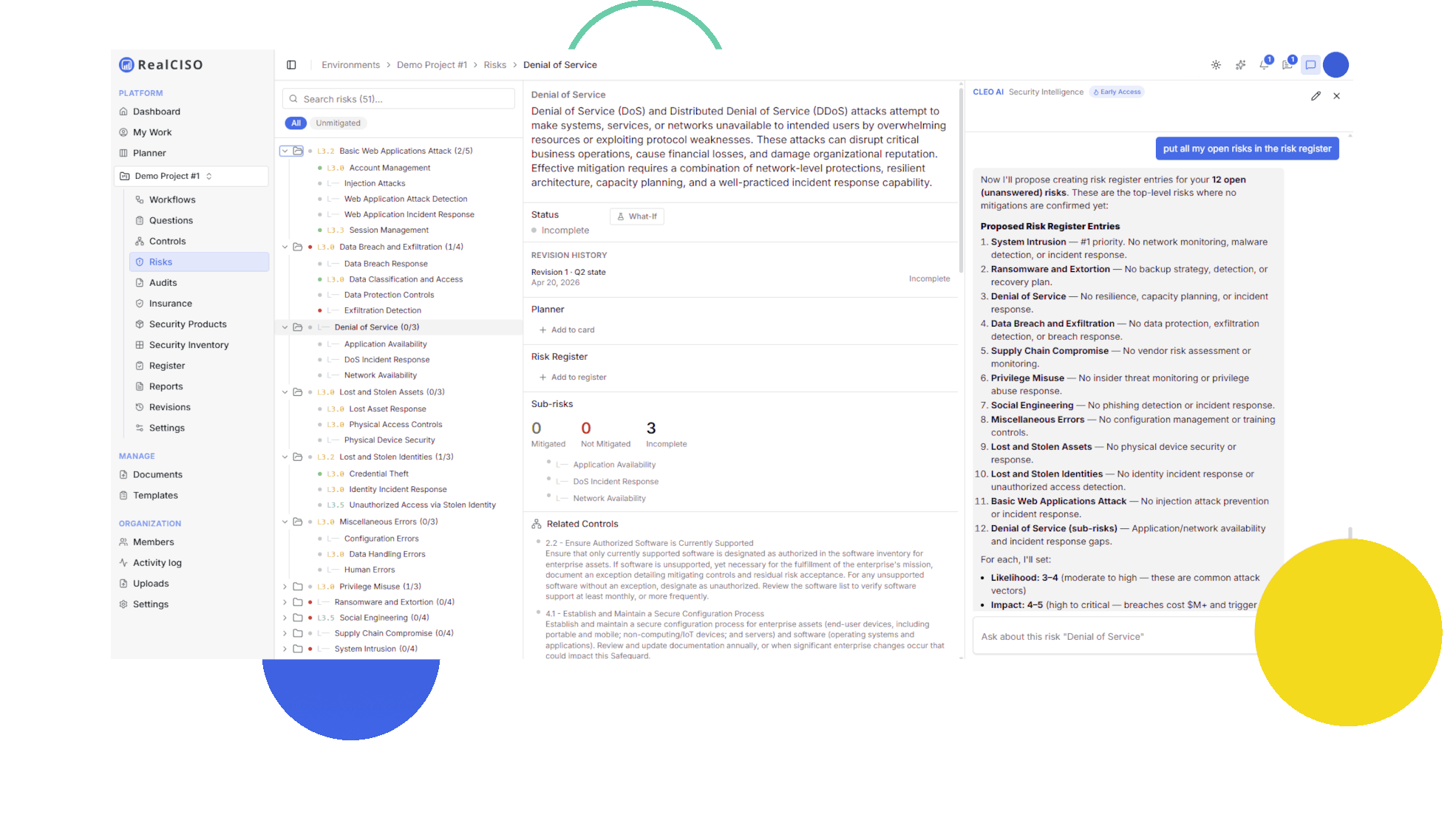
RealCISO’s AI doesn’t assist — it executes. Cleo has direct access to your compliance data graph and reasons across the full structure: Controls, Risks, Evidence, Vendors, Policies, and People.
Cynomi’s CISO Intelligence takes the opposite architectural bet: four role-based agents — a CISO, an Auditor, an Analyst, an Executive Communicator — each producing polished output for the engagement in front of it. It is a genuinely good way to generate a deliverable. What it does not do is remember. Ask any of those four agents which gap to close first and it can reason about your posture today; it cannot tell you how much your score moves if you close it, because nothing behind it is holding a baseline to measure the delta against.
That is the whole difference, and it compounds. Cleo gets more useful with every piece of evidence collected, every gap closed, every quarter of maturity history recorded. An agent without persistent state is exactly as smart on day 400 as it was on day 1.
RealCISO includes every framework at every tier — no separate licensing, no per-framework charges. Assess a client across multiple frameworks simultaneously with one evidence set.
RealCISO tracks security maturity over time using an L1–L5 progression per control, simulates the impact of closing gaps before you act, and surfaces portfolio intelligence across all clients. Cynomi generates AI-driven assessment snapshots and prioritizes sales and GTM methodology for MSPs. RealCISO shows where your client’s security program is heading; Cynomi tells you where it stands today.
RealCISO ships NIST CSF 2.0, HIPAA 2.0, SOC 2, ISO 27001, CIS Controls v8, NIST 800-171, NIST 800-53, CMMC 2.0, PCI-DSS, FedRAMP, RMF and NIST AI RMF, with more than 1,000 controls pre-baked and additional frameworks added through our bundle architecture. The number matters less than the billing model: every framework is included for every customer. You are never quoted an add-on to assess a client against a second framework, and one evidence set maps across all of them — so adding NIST CSF to an existing HIPAA client costs you nothing and takes one project, not two.
Yes — 15 integrations running 386 automated tests on a 12-hour cadence, spanning cloud (AWS, Azure, GCP), identity (Microsoft 365, Google Workspace, Okta), endpoint and MDM (Intune, Jamf, Kandji, ConnectWise), EDR (CrowdStrike) and vulnerability management (Qualys, Tenable). Every integration is read-only, credentials are envelope-encrypted and decrypted in memory only at sync time, and AWS uses IAM role assumption with an external ID rather than a stored long-lived credential.
Cynomi added seven vulnerability-scanner integrations in June 2026, so scanner data is no longer the difference. The difference is coverage and provenance: scanners see endpoints, while control coverage also lives in your identity provider, your cloud configuration and your device management — and RealCISO keeps automated test results separate from assessed control state, so a machine observation informs your assessor instead of silently deciding a control is met.
Yes. Portfolio Intelligence is a core platform pillar. MSPs can view cross-client pattern recognition, evidence expiration ranked by risk impact and audit proximity, and per-client maturity benchmarks. One analyst can manage 20+ client programs in a single multi-tenant instance.
RealCISO’s simulate_project feature lets you rank every open gap by how much your security score would improve if you closed it. You can also run what-if scenarios: “If I implement this control, how much does our score improve?” This helps prioritize remediation by business impact before your team does the work. No other vCISO platform has equivalent functionality.
Yes. RealCISO supports full white-label delivery including custom domains, logos, and primary color schemes via report profiles. Your clients see your brand, not RealCISO’s.
RealCISO publishes its pricing. Per-client tiers, billed the way MSPs already structure client revenue, with no per-framework add-ons and no minimum client count — you can start with one client and grow from there.
Cynomi does not publish dollar figures. As of August 2026 they offer four paths — one-time assessments, Cynomi Core, Cynomi Pro, and TPRM — priced on a per-account basis, with assessment packs available in sizes of 1, 5, 10 and 20. If you are comparing the two, ask both vendors the same three questions: what is the total first-year cost for the client count I actually have today, what happens to that number when I add a framework, and what am I committed to if I lose a client in month four.
Yes. RealCISO launched a full GRC Platform path in May 2026 for enterprise CISOs, compliance officers, and in-house security teams. The same compliance data graph and AI engine serve both service providers and direct enterprise users. Cynomi is exclusively focused on the MSP and service provider channel.
Both. Assessments tell you where a client stands; audits are a different job, and RealCISO tracks them as one. Build the auditor’s request list inside the platform — seeded from a framework’s assessor requirements or from a target maturity level — give every request an owner and a due date, and move it from Open through Ready, Submitted and Accepted. Fulfilment is calculated from the evidence actually collected during the audit window rather than asserted by whoever is closest to the deadline, and submission packages export organised by request, with each folder stating what was asked, which controls it maps to, what was delivered, and what was excluded and why. Open, due-soon and overdue requests appear in each owner’s task list and in the weekly digest.
Maturity trajectory. Impact simulation. Portfolio intelligence across every client. Start with a live demo or go hands-on in the platform now.