By Brian Haugli, CEO of RealCISO and author of Cybersecurity Risk Management: Mastering the Fundamentals Using the NIST Cybersecurity Framework (Wiley, 2021). Last reviewed: October 2026.
Best Enterprise GRC Platforms: How to Choose Between Vanta, Drata, RealCISO, and Apptega
Your board just mandated NIST CSF 2.0 compliance across all subsidiaries. Your auditors are asking for SOC 2 Type II evidence. Your federal contractor business unit needs CMMC 2.0 certification. And your compliance team is drowning in spreadsheets.
Enterprise GRC software is supposed to fix this. Today’s leading compliance automation platforms, including Vanta and Drata, all cross-map controls and support multiple business units in some form. So the real differences show up in four places:
- How compliance rolls up across 5+ entities, and what each additional entity costs
- Whether every framework is included or sold as an add-on
- Whether controls are scored on maturity (L1 to L5) and trended over time, or only marked pass/fail
- Whether pricing is published or quoted after a sales cycle
This guide walks you through:
- What enterprise GRC actually is, and how it differs from SaaS-focused compliance automation
- Six critical evaluation criteria
- A head-to-head comparison of Vanta, Drata, RealCISO, and Apptega
- A decision framework for picking the platform that fits your organization
- Implementation timeline and budget
Not sure which platform fits? Start with where you actually stand.
Run a free RealCISO assessment against NIST CSF, SOC 2, HIPAA, or CMMC. No credit card, no sales call.
Start a free assessment →What Enterprise GRC Actually Does (And Why It Matters)
GRC software centralizes three interconnected activities:
- Governance: Policies, controls, and decision-making frameworks per NIST CSF 2.0, ISO 27001, CIS Controls, or your chosen standard
- Risk: Identifying, assessing, and prioritizing risk: what can go wrong, how likely it is, and what it costs to remediate
- Compliance: Meeting regulatory requirements (SOC 2, HIPAA, CMMC 2.0, NIST CSF 2.0, etc.) and staying audit-ready
When governance, risk, and compliance operate in silos, you lose visibility and create audit gaps. A control in your ERP system maps to a NIST CSF outcome, which maps to a risk you identified last quarter, which is evidence for your SOC 2 audit. When one changes, everything else should update automatically.
Why Enterprise GRC Is Different From SaaS GRC
SaaS-focused GRC platforms are optimized for speed to a first audit. They ask: “How fast can we get you audit-ready?”
Enterprise GRC platforms are optimized for long-term program maturity across multiple entities and frameworks. They ask: “How do we help you mature your entire compliance program over years, across all your subsidiaries?”
Enterprise programs need three things done well:
- Multi-framework management. You don’t just need NIST CSF 2.0. You need NIST CSF 2.0, ISO 27001, CMMC 2.0, and SOC 2 at the same time. Most modern platforms cross-map controls, so ask how frameworks are priced (included or per-framework add-ons) and what happens to every mapped framework when a piece of evidence expires.
- Multi-entity visibility. If you have subsidiaries, acquired companies, or multiple business units, you need one view across all of them. Executives need to know whether every entity is audit-ready and which one carries the most risk. Ask whether entities are isolated, how they roll up to the parent, and what each additional entity costs.
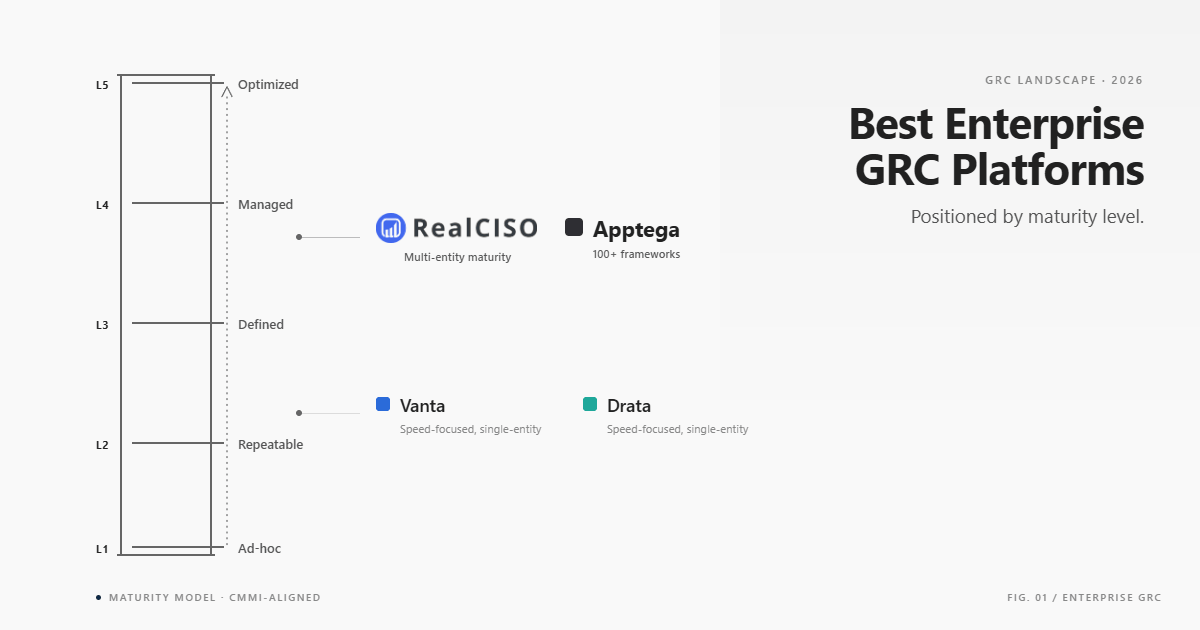
- Maturity-based prioritization. A control operating at L2 (repeatable) needs a different fix than one at L4 (managed). Pass/fail status tells you whether a control exists, not how well it runs or whether it’s improving.
Key Evaluation Criteria for Enterprise GRC
Before comparing tools, understand the six evaluation dimensions that matter most:
1. Multi-Framework Mapping
Does the platform map controls across frameworks automatically, and does one piece of evidence credit every control it satisfies?
Example: NIST CSF 2.0 ID.RA-01 (vulnerabilities in assets are identified) → ISO/IEC 27001:2022 A.8.8 (management of technical vulnerabilities) → CIS Controls v8 7.1 (establish and maintain a vulnerability management process)
This matters because auditors ask, “Show me how your NIST assessment supports your SOC 2 evidence.” If your platform requires manual mapping, you’ll lose months to spreadsheet work.
Red flag: Platforms that charge extra per framework or limit how many frameworks you can run at once.
2. Maturity Tracking (L1–L5)
Can the platform score controls from L1 (Ad-hoc) to L5 (Optimized) and track maturity over time?
Maturity scale:
- L1 (Ad-hoc): Manual processes, no standard approach
- L2 (Repeatable): Documented and followed consistently
- L3 (Defined): Standardized and enforced through policy
- L4 (Managed): Measured and data-driven
- L5 (Optimized): Continuously improved through automation and analytics
Why maturity matters:
- Boards want to see progress: “We moved identity controls from L2 to L3 this quarter.”
- SOC 2 auditors test whether controls are designed and operating effectively. Documented, repeatable processes (L3) are far easier to evidence than ad-hoc ones.
- CMMC Level 2 requires implementing all 110 NIST SP 800-171 requirements. Maturity scoring shows how far each requirement is from that target and what to fix first.
- Trending maturity over quarters shows whether your program is improving or just passing audits.
Red flag: Platforms that score controls as compliant or non-compliant without measuring maturity.
3. Portfolio Intelligence
For multi-entity organizations, can the platform answer these questions?
- Which of my 15 subsidiaries has the highest compliance risk?
- Which 10 controls, if fixed, would reduce risk most across my entire portfolio?
- How does each entity’s maturity compare with the others?
This is what separates enterprise platforms from mid-market tools.
4. Evidence Management at Scale
Enterprise evidence management needs to handle:
- Multiple evidence types: Policies (PDF), screenshots, audit logs (automated feeds), vendor attestations (SOC 2 reports, BAAs), and third-party questionnaires
- Evidence expiration tracking: Evidence ages. Annual assessments need a refresh and SOC 2 reports rotate yearly, so the platform should alert you when evidence goes stale.
- Cross-framework association: One piece of evidence, such as a network segmentation audit log, proves multiple controls across multiple frameworks. Link it once and reuse it everywhere.
5. Vendor Risk Management (TPRM)
For enterprises, third-party risk is critical. Look for:
- Vendor questionnaires that vendors complete through a portal
- BAA tracking
- Vendor SOC 2 and ISO 27001 attestation management
- Explainable risk scoring, so you can see why a vendor scored the way it did
- Pricing that doesn’t scale per vendor
6. Implementation Path & Timeline
Ask every vendor two separate questions. First, how long does setup take (environments, frameworks, SSO, integrations)? Second, how long until we’re audit-ready, given our starting maturity? The second answer depends far more on your program than on the software.
The Four Leading Enterprise GRC Platforms
Platform 1: RealCISO
Ideal for: Mid-market to enterprise organizations with 2+ entities, federal contractors (CMMC 2.0), and teams that need maturity progression and portfolio visibility
Core Strengths:
- L1–L5 maturity tracking per control, with trending. See which controls are repeatable and which are optimized, and track progress quarter over quarter. Maturity carries into every framework that uses the control.
- Portfolio intelligence. Isolated environments per entity, consolidated reporting at the parent, and enterprise-wide risk prioritization. Enterprise Plus adds portfolio rollup and cross-environment benchmarking.
- 30+ frameworks with automatic cross-mapping, included in every plan. NIST CSF 2.0, NIST 800-53, NIST 800-171 Rev. 3 (with SPRS scoring), ISO/IEC 27001:2022, CIS Controls v8, CMMC 2.0, HIPAA, SOC 2, PCI-DSS, FedRAMP, and more. No per-framework fees.
- Built-in vendor risk management. AI-scored questionnaires (0–100, with explainable findings), a branded vendor portal, and tiered review cadences, for $100/month with unlimited vendors. TPRM is included on Enterprise.
- Continuous Compliance. Connect AWS, Azure, or GCP and Okta, Entra, or Google to run 24/7 control tests. That typically automates 60–70% of applicable tests.
Timeline to audit-ready: 2–6 months (maturity-focused, not just audit-speed-focused)
Pricing: Published. Free tier · Essentials $3,600/yr · Professional $15,000/yr · Enterprise $50,000/yr (3 environments, TPRM and Continuous Compliance included) · Enterprise Plus scoped to your portfolio. Onboarding is free on every plan. See full pricing →
Best if: You have 2+ entities, need maturity tracking, or manage vendor compliance at scale
Why teams pick RealCISO
Compliance intelligence. Not just compliance software.
Multi-framework mapping, L1–L5 maturity tracking, and portfolio intelligence in one platform, built by the author of Wiley’s guide to the NIST Cybersecurity Framework.
Book a demo → Compare platformsPlatform 2: Vanta
Ideal for: SaaS, fintech, and tech companies that want automated evidence collection and a fast path to SOC 2, especially with cloud-native infrastructure
Core Strengths:
- Deep cloud evidence automation. Connects to AWS, Azure, GCP, Okta, GitHub, and more to collect control evidence automatically.
- Cross-framework controls. The Vanta Control Framework maps common controls across supported frameworks such as SOC 2, ISO 27001, and GDPR.
- Workspaces. Separate workspaces per business unit, with a parent workspace that rolls up risk and compliance status.
- Risk and vendor risk. Inherent-risk scoring for vendors. In June 2026 Vanta launched an Agent for Risk that brings internal and third-party risk into one view.
Pricing: Not published; quoted after a sales conversation.
Best if: You’re a cloud-native SaaS company prioritizing SOC 2 speed
Platform 3: Drata
Ideal for: SaaS and fintech companies running SOC 2 alongside HIPAA or ISO 27001
Core Strengths:
- Drata Control Framework. Controls map to requirements across multiple frameworks, so evidence is reused.
- Strong integrations. If your critical apps are integrated, evidence collection is faster.
- Workspaces. Separate workspaces for entities or products that are audited separately, with controls that can be linked across them.
- Third-party risk management. Drata made a standalone agentic TPRM product generally available in September 2026.
Pricing: Not published; quoted by plan (Foundation, Advanced, Enterprise).
Best if: You’re a SaaS company that wants automation across a few common frameworks
Platform 4: Apptega
Ideal for: MSPs, MSSPs, and consultants delivering compliance across many clients, plus in-house teams in regulated sectors
Core Strengths:
- 30+ cross-mapped frameworks, including CMMC, NIST CSF, SOC 2, PCI DSS, HIPAA, and ISO 27001
- Multi-tenant delivery, with customizable client environments
- Risk and third-party modules, including a risk manager, third-party risk, and security questionnaire automation
Pricing: Not published.
Best if: You’re a service provider managing compliance for a book of clients. If that’s you, also compare RealCISO’s partner program: published client licenses from $42/client/month, a white-label workspace, and portfolio opportunity ranking across your whole client base.
What About ServiceNow, Archer, AuditBoard, and LogicGate?
Traditional enterprise GRC and IRM suites are highly configurable and built for large risk, audit, and compliance functions. In exchange, implementations are often long, professional-services fees are significant, and you usually need a dedicated administrator. If you already run one, it may be the right home for enterprise risk. If you need multi-entity compliance with maturity tracking that your security team can operate itself, with published pricing and setup measured in sessions rather than quarters, compare RealCISO.
Head-to-Head Decision Framework
| Your Situation | Best Platform | Why |
|---|---|---|
| Single-entity SaaS; need SOC 2 fast | Vanta, Drata, or RealCISO | All three automate cloud evidence. RealCISO adds published pricing and maturity scoring from day one. |
| Single-entity SaaS; need SOC 2 + HIPAA; budget is tight | RealCISO or Drata | RealCISO includes every framework on every plan (Professional is $15,000/yr for 3 compliance sets). |
| 2–10 entities; need to show maturity progress to the board | RealCISO | L1–L5 maturity per control, trended across quarters, plus isolated entity environments with parent rollup. |
| Federal contractor; need CMMC 2.0 + NIST CSF + mapping | RealCISO | CMMC 2.0 Levels 1–2 mapped to NIST SP 800-171 Rev. 3 with SPRS scoring and C3PAO integration. |
| Need 5+ frameworks mapped simultaneously | RealCISO or Apptega | Both offer 30+ cross-mapped frameworks. RealCISO includes all of them in every plan at published prices. |
| MSP, MSSP, or consultant serving many clients | RealCISO or Apptega | Both are multi-tenant. RealCISO publishes partner pricing and white-labels the workspace. |
| Enterprise (500+ employees); manage vendor compliance at scale | RealCISO | TPRM, portfolio intelligence, and maturity tracking in one platform, with TPRM included on Enterprise. |
How to Evaluate: 5 Questions to Ask Each Vendor
1. “Show me five frameworks running at once. Is every framework included, or priced per framework? When evidence expires, which frameworks get flagged?”
- RealCISO: Every framework is included in every plan. One evidence node credits every control it satisfies, and expiry flags every framework that relied on it.
2. “How do you track maturity? What does ‘compliant’ mean to you?”
- RealCISO: L1–L5 scoring per control, trended across quarters, so you can show progress from L2 to L3.
3. “Show me one dashboard with all my entities. How do entities roll up, and what does each additional one cost?”
- RealCISO: Enterprise includes 3 isolated environments with consolidated parent reporting. Additional environments are $5,000/yr, and Enterprise Plus adds portfolio rollup and benchmarking.
4. “What does implementation look like? How long until we’re audit-ready?”
- RealCISO: Environments, frameworks, SSO, and integrations are configured in working sessions, with free onboarding. Audit-ready typically takes 2–6 months, depending on starting maturity.
5. “Show me vendor management. Is TPRM included or separate? Is pricing per vendor? How is the vendor score calculated?”
- RealCISO: $100/month for unlimited vendors (included on Enterprise). Cleo produces a 0–100 score with category breakdowns and draft findings that you accept, modify, or dismiss.
Implementation Checklist
Timeline
- Month 1: Framework selection, tool setup, team onboarding
- Month 2: Control mapping, policy development, evidence strategy
- Months 3–6: Assessment execution, gap identification, remediation planning
- Months 6–12: Remediation execution, maturity progression, audit prep
Budget
- Software: Varies widely by vendor, entity count, and frameworks. Many vendors quote only after a sales call, so compare the total cost, including framework add-ons, TPRM, and renewal escalators. RealCISO’s published range runs from free to $50,000/yr for Enterprise.
- Implementation services (optional): Depends on scope. Traditional enterprise suites often require significant professional-services engagements.
- Internal time: 0.5–2 FTE for mid-market; 3–5 FTE for large enterprises
Staffing
- GRC Lead: Strategy, framework selection, board reporting
- Compliance Manager: Assessments, evidence, auditor coordination
- Risk Manager: Remediation prioritization, risk register
- Technical Lead: Integrations, automation, evidence feeds
The Bottom Line
Vanta or Drata if you’re a cloud-native SaaS company whose priority is SOC 2 speed and deep evidence automation.
RealCISO if you have 2+ entities, need maturity tracking across frameworks, manage vendor compliance, or want published pricing with every framework included. It’s especially strong for CMMC 2.0 contractors.
Apptega if you’re a service provider delivering compliance to many clients and want a multi-tenant platform with broad framework coverage.
Next Steps: Choose Your Platform
For SaaS Companies
- Request demos from Vanta, Drata, and RealCISO
- Ask: “What’s your timeline to SOC 2 audit-readiness for our tech stack?”
- Compare automation coverage and total cost, including framework add-ons
For Multi-Entity Enterprises
- Request a demo from RealCISO and any other platform on your shortlist
- Ask to see portfolio dashboards built on your entity structure
- Discuss maturity tracking: “How would you measure our progress over 3 years?”
For Federal Contractors (CMMC 2.0)
- RealCISO offers CMMC 2.0 Levels 1–2 templates, NIST SP 800-171 Rev. 3 with SPRS scoring, and C3PAO integration
- Request a demo and ask: “Walk me through our CMMC 2.0 readiness assessment”
Frequently Asked Questions
Is RealCISO an alternative to Vanta and Drata?
Yes. All three automate compliance evidence across multiple frameworks. RealCISO adds L1–L5 maturity scoring per control, isolated multi-entity environments with parent rollup, built-in TPRM, and published pricing with every framework included in every plan.
How much does RealCISO cost?
RealCISO publishes its pricing: Free, Essentials $3,600/yr, Professional $15,000/yr, Enterprise $50,000/yr, and Enterprise Plus scoped to your portfolio. Onboarding is free and there are no per-framework fees.
Does RealCISO support multiple subsidiaries or business units?
Yes. Enterprise includes three isolated environments with consolidated reporting at the parent, and additional environments are $5,000/yr. Enterprise Plus links multiple licenses with portfolio rollup and cross-environment benchmarking.
How many frameworks does RealCISO support?
30+ frameworks, including NIST CSF 2.0, SOC 2, ISO/IEC 27001:2022, HIPAA, CMMC 2.0, NIST 800-171 Rev. 3, NIST 800-53, CIS Controls v8, PCI-DSS, and FedRAMP. Every framework is included in every plan.
How long does it take to become audit-ready with RealCISO?
Typically 2–6 months, depending on your starting maturity. Setup of environments, frameworks, SSO, and integrations happens in working sessions with free onboarding.
Get Help Choosing Your Enterprise GRC Platform
We help enterprise organizations assess their compliance maturity, select the right GRC platform, and design programs that scale across multiple entities and frameworks.
Whether you choose RealCISO or another platform, our team can help you:
- Assess your current maturity (L1–L5)
- Map your compliance requirements across frameworks
- Plan a multi-year compliance program
- Integrate your platform with security and IT operations
Two ways to get started
Explore it yourself
Spin up a free account and run your first framework assessment in minutes.
Start free →Talk to an expert
Get a 30-minute walkthrough mapped to your frameworks and entity structure.
Book a demo →